
Why Dog Walking Flyers Fail
And How to Fix Yours
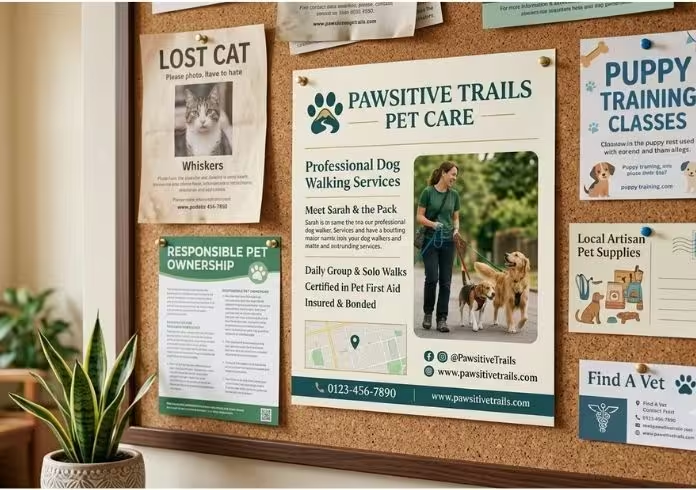
You spent time designing your flyer. You printed a stack of them. You put them up around the neighbourhood, posted them through doors, left a few at the local pet shop. Then you waited.
Nothing happened.
A few weeks passed. You went back to check on the ones you had pinned up and half of them had been taken down or covered by something else. The ones still up looked a little tired. Your phone had not rung once.
If this sounds familiar, you are not alone. The majority of dog walking flyers simply do not work. Not because flyers do not work as a marketing tool, they absolutely do, but because most of them make the same avoidable mistakes that guarantee they get ignored.
This article breaks down exactly why most dog walking flyers fail, what to do differently, and how to build a flyer that actually generates enquiries from the right people in your local area.
KEY TAKEAWAYS
- Most dog walking flyers fail not because of bad design but because they lead with the wrong information and give the reader no compelling reason to act.
- A flyer that tries to say everything ends up communicating nothing, so keeping your message focused on one clear offer and one clear action is essential.
- Trust signals such as a real photo, a client quote, and a professional appearance matter more on a flyer than a list of services because they answer the reader’s first question, which is whether you are someone they can trust with their dog.
- Where you place your flyer matters as much as what it says, and a single well-placed flyer in the right location will outperform fifty randomly distributed ones every time.
- Adding a QR code that links directly to your booking page or a special offer turns a passive piece of paper into an active lead generation tool.
A dog walking flyer is a printed or digital single-page marketing document used to advertise dog walking services to local pet owners. When designed and distributed well, a flyer communicates who you are, what you offer, where you work, and how to get in touch in a way that builds enough trust and curiosity for a potential client to take action. When designed poorly, it gets ignored, lost in a pile of other notices, or thrown away without a second glance.
The Reason Most Flyers Get Ignored Immediately
Before you can fix your flyer, it helps to understand what is happening in the mind of the person who sees it.
Someone walks past your flyer on a notice board. They are in the middle of something. They glance at it for roughly two seconds. In those two seconds their brain is doing one thing: deciding whether this is worth their attention.
If your flyer does not answer the question “why does this matter to me right now” within those two seconds, they move on and forget it instantly. This is not rudeness. It is the normal way human attention works when we are surrounded by competing information.
Most dog walking flyers fail this two-second test because they open with the wrong thing. They lead with the business name, a generic tagline, or a long list of services. None of these answer the reader’s immediate question. None of them give a reason to keep reading.
The fix is simple but it requires a shift in how you think about the flyer’s job. Its job is not to tell people everything about your business. Its job is to earn two more seconds of attention, then two more, until the reader has seen enough to want to get in touch.
The Six Most Common Dog Walking Flyer Mistakes
❌ Mistake 1: Putting your business name as the headline
Your business name means nothing to someone who has never heard of you. Leading with it is the equivalent of opening a conversation with a stranger by saying your own name and then falling silent. It communicates nothing useful and gives no reason to keep reading.
Fix it: Replace your business name headline with a benefit-led statement that speaks directly to the reader’s situation. For example:
- “Your dog deserves a great walk every day, even when you are stuck at work”
- “Reliable, fully insured dog walking right here in [your area]”
- “Your dog walked, loved, and home safe. Every time.”
Your business name still appears on the flyer, just not as the headline.
❌ Mistake 2: Listing every service you offer
A flyer that lists solo walks, group walks, puppy walks, drop-in visits, holiday cover, senior dog walks, and dog sitting all at once overwhelms the reader and dilutes the message. Too many options create decision fatigue, and a person experiencing decision fatigue does the easiest thing: nothing.
Fix it: Lead with one primary service for the flyer’s main message. If you want to mention others, list them briefly at the bottom under “Also available” rather than giving them equal prominence with your core offer.
❌ Mistake 3: No trust signals
A pet owner is being asked to hand their dog to a stranger. Before they will even consider calling the number on a flyer, they need to feel some level of trust. Most flyers provide none.
Fix it: Include at least two of the following trust signals on your flyer:
- A real, friendly photo of you with a dog. Not a stock image and not just a logo. A real photo of a real person.
- A short client quote in quotation marks, for example “Charlie comes home so happy after every walk. I would not use anyone else.” with a first name and neighbourhood beneath it.
- A statement that you are fully insured, for example “Fully insured and police checked” if applicable.
- A note about experience, for example “Five years of experience with dogs of all sizes and temperaments.”
Even one or two of these elements changes the feel of the flyer completely. It goes from an anonymous advertisement to the introduction of a real, trustworthy person.
❌ Mistake 4: No clear call to action
A call to action is the instruction that tells the reader exactly what to do next. Many dog walking flyers include contact details but no actual instruction, which seems obvious but makes a meaningful difference to response rates.
Fix it: Tell the reader exactly what to do and make it as easy as possible. Examples:
- “Text [number] today to book a free meet and greet”
- “Scan the QR code below to check availability and book online”
- “Call or WhatsApp [number] and mention this flyer for your first walk free”
The instruction should feel easy, low-risk, and immediate. “Get in touch” is too vague. “Text me today” is specific and actionable.
❌ Mistake 5: Too much text
A flyer is not a brochure. It is not a website page. It is a quick-glance communication tool and every word that is not earning its place is getting in the way of the words that are.
Fix it: Read through every line of your flyer and ask whether removing it would reduce the reader’s chance of getting in touch. If the answer is no, remove it. Aim for the minimum amount of text needed to communicate your offer, build basic trust, and direct the reader to take action.
White space is not wasted space on a flyer. It makes the important information stand out and gives the eye somewhere to rest.
❌ Mistake 6: Poor visual presentation
A flyer that looks homemade, cluttered, or low quality sends a message about your business whether you intend it to or not. A pet owner looking for someone to trust with their dog will make quick judgments based on what is in front of them.
Fix it: Use a design tool like Canva to create your flyer rather than a basic word processor. Choose one or two fonts and stick to them. Use a consistent colour palette that matches your brand. Make sure your photo is clear and well-lit rather than a blurry phone snapshot. Leave enough space between elements so the layout breathes.
You do not need to be a designer to produce a professional-looking flyer. A clean, simple Canva template customised with your details will always outperform a busy, overcrowded design made from scratch.
What a High-Converting Dog Walking Flyer Actually Looks Like
Here is a simple structure that works. Think of it as a template for the content layout rather than a rigid design rule.
Top third: Headline and trust hook
A benefit-led headline that speaks directly to the reader’s situation followed immediately by a trust signal. A real photo of you with a dog works well here positioned beside or beneath the headline.
Example: “Trustworthy, local dog walking in [your neighbourhood]” Beneath it: A photo of you with a happy dog. Beside it: “Fully insured, DBS checked, five years experience.”
Middle third: The offer and social proof
Your core service stated simply, your price range or a specific introductory offer, and a short client quote.
Example: “Solo and group walks available, from [price] per walk. First walk free for new clients this month.” Beneath it: “We have used [name] for two years and could not be happier. She treats our dog like her own.” followed by a first name and neighbourhood.
Bottom third: The call to action
One clear instruction, your contact details, and a QR code.
Example: “Text or WhatsApp [number] to book your free meet and greet” QR code linking to your booking page or a Google Form for new client enquiries. Website or booking link in small text beneath the QR code. Instagram handle if you post regularly.
That is the entire flyer. Nothing else is needed.
Where You Place Your Flyer Matters as Much as What It Says
Even a perfectly designed flyer placed in the wrong location will not generate enquiries. Placement strategy matters.
High-value locations:
- Vet clinic waiting rooms and reception desks. Ask permission and offer to replenish supplies regularly.
- Grooming salons. Dog owners visiting a groomer are already investing in their dog’s care and are a warm audience.
- Pet supply shops. The notice board or reception counter of an independent pet shop reaches a concentrated audience of local dog owners.
- Dog-friendly cafes and pubs. People who bring their dogs to social spaces are engaged, community-oriented pet owners.
- Community centre notice boards. Reached by local residents who are already primed to support local businesses.
Lower-value locations to deprioritise:
- Random door drops across wide areas with no targeting
- General supermarket notice boards shared with dozens of unrelated services
- Lampposts and public fences, which look unprofessional and often violate local bylaws
Refresh your notice board placements every four to six weeks. A flyer that has been up for three months looks dated and stops being noticed. A fresh, clean copy resets the attention it receives.
The QR Code: Turning a Passive Flyer Into an Active Lead Tool
Adding a QR code to your flyer is one of the single highest-impact changes you can make. It removes the step of saving a phone number, typing a website, or remembering to follow up later. The reader sees your flyer, scans the code, and lands directly on your booking page or enquiry form in seconds.
How to set up your QR code:
- Use a free QR code generator such as QR Code Generator or Canva’s built-in QR tool in our flyer
- Link it to your booking page, your Google Business Profile, or a simple Google Form for new client enquiries
- Test the code before printing by scanning it yourself on multiple devices
- Make sure the page it links to is mobile-friendly since every person scanning a flyer QR code is on their phone
Place the QR code in the bottom section of your flyer with a short instruction beside it such as “Scan to book online” or “Scan to check availability.” Make it large enough to scan easily, at least 2.5cm square on a printed flyer.
Track Whether Your Flyer Is Working
Most dog walkers never know whether their flyers are generating enquiries because they never set up a way to track it. Without tracking, you cannot improve.
Simple tracking methods:
- Ask every new enquiry how they heard about you and record the answer
- Use a unique phone number or WhatsApp link on your flyer that is different from your main number so you can see which calls came from flyer distribution
- Create a specific landing page or Google Form linked to the flyer QR code so you can see how many people scanned it
- Include a flyer-specific offer code such as “mention FLYER for your first walk free” so you know when an enquiry came from the printed material
Even just asking “how did you hear about me” every time gives you enough data over a few months to know whether your flyer placement is working and where to focus your distribution efforts.
Have you read?
FAQ: Why Dog Walking Flyers Fail
Yes, when they are designed and placed correctly. Physical flyers remain one of the most cost-effective local marketing tools for dog walkers because they reach pet owners in the exact local area you serve. The issue is not the format. It is the execution.
A benefit-led headline, a real photo of you with a dog, one clear offer, a short client quote, and a single specific call to action. If your flyer has all five of these elements it will outperform almost every other dog walking flyer in your area.
Including a price range or a starting rate reduces friction for readers who might otherwise hesitate to contact you because they are not sure whether you are within their budget. It also pre-qualifies your enquiries so you spend less time talking to people who are not a realistic fit. A note like “walks from $15” or “prices from $20 per hour” is enough.
Start with a print run of 100 to 200 and focus entirely on high-quality placements rather than wide distribution. A focused run placed in vet clinics, pet shops, and grooming salons will generate more enquiries than 500 random door drops. Once you know your placement strategy is working, scale up your print run.
A5, which is half of a standard A4 sheet, is the most practical size for notice board placement. It is large enough to include all necessary information and a photo but small enough to fit neatly among other notices without dominating the board. For door drops, A5 also works well and costs less to print than full A4.
Absolutely. A real, friendly photo of you with a dog is one of the most powerful trust-building elements you can include. It answers the most important question on the reader’s mind, which is whether you are a real, approachable person rather than a faceless business. Stock images do not have the same effect because experienced readers recognise them immediately.
Review your flyer every three to four months. Update the offer if it has changed, refresh any client quotes with newer ones, and check that all contact details and links are still correct. A flyer that has been unchanged for a year starts to feel dated. A small refresh keeps it looking current and gives you a reason to replenish your placements.